

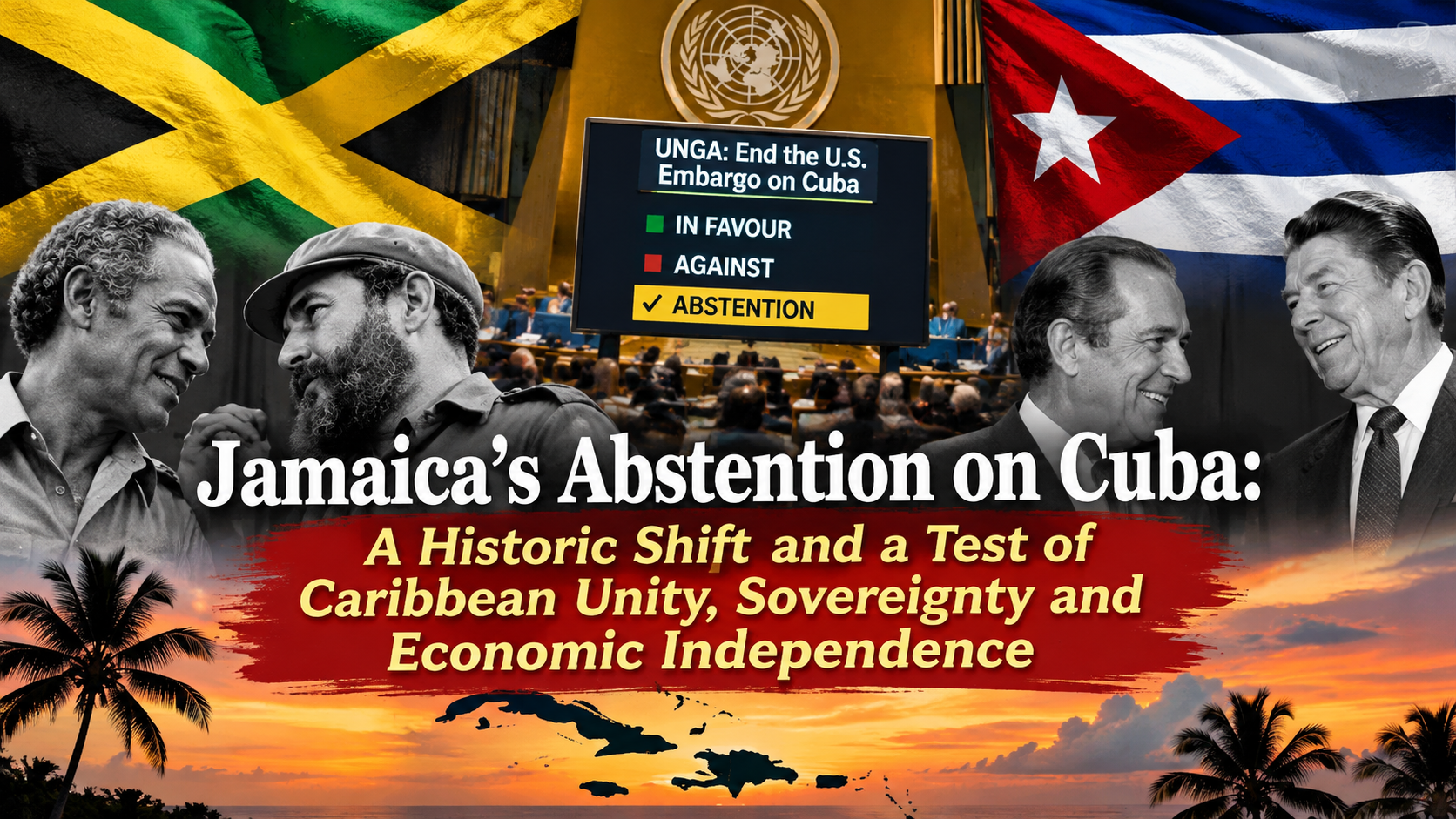
On October 28, 2026, Jamaica made a historic policy shift, abstaining for the first time from a United Nations General Assembly (UNGA) resolution calling for an end to the United States’ economic, commercial, and financial embargo against Cuba. The decision raises serious questions about Jamaica’s commitment to Caribbean unity, economic freedom, regional sovereignty, and the fight against economic injustice. The resolution passed with 130 countries voting in favor, 17 against, and 25 abstaining. Jamaica’s decision breaks with its longstanding support for ending the embargo and raises concerns about the direction of its foreign policy. The United States’ decades-long embargo has contributed to Cuba’s economic hardship by restricting trade, investment, and access to international markets. The embargo must be understood in the context of the historic struggle between Cuba and the United States over political independence, economic control, and sovereignty. Cuba has consistently resisted American intervention and efforts to shape its political and economic direction, demonstrating the resolve of a people determined to preserve their autonomy.
Cuba’s fight for autonomy and sovereignty is closely connected to the wider Caribbean struggle for economic and political independence. Since European colonization began in the late fifteenth century, Caribbean peoples have fought to shape their political and economic futures through slavery, emancipation, independence movements, and the revolutionary struggles of the twentieth century. Jamaica’s decision must be understood within this broader history. The country has a controversial legacy in Caribbean political integration: its withdrawal from the West Indies Federation after the 1961 referendum contributed significantly to the Federation’s collapse in 1962, weakening the prospect of a united West Indian nation. The Treaty of Chaguaramas, signed in 1973, later established the Caribbean Community (CARICOM) as another framework for regional integration. Yet the vision of Caribbean unity and collective sovereignty remains unrealized. In this historical context, Jamaica’s abstention raises fresh questions about its commitment to regional solidarity, especially given Cuba’s longstanding relationships with Jamaica and other Caribbean nations.
Cuba has made significant contributions to the region through medical cooperation, education, scholarships, and the sharing of medical professionals. Jamaican students have benefited from medical training in Cuba, while Cuban doctors and other healthcare workers have served communities across the Caribbean. These ties show that Caribbean cooperation need not be shaped entirely by the economic and political interests of powerful external nations. Previous Jamaican administrations maintained close relations with Cuba despite disagreements with Washington. However, the historical ties between Jamaica’s two major political parties and the United States remain relevant when considering the current administration’s decision. Under Michael Manley, Jamaica forged particularly close ties with Fidel Castro and revolutionary Cuba. Manley’s focus on democratic socialism, economic independence, and Third World solidarity brought Jamaica into closer cooperation with Cuba, to the displeasure of Washington and his political opponent, Edward Seaga. After becoming prime minister in 1980, Seaga pursued closer relations with the United States under President Ronald Reagan, reflecting a different ideological and economic outlook. This history remains relevant today. The Jamaica Labor Party’s historical alignment with American economic and foreign policy raises questions about whether the current administration’s decision continues that orientation. However, historical ties alone do not establish the motives behind the October 2026 abstention.
The Jamaican government has denied that American pressure influenced its decision. Foreign Affairs Minister Kamina Johnson Smith said Jamaica opposes unilateral embargoes but believes the annual resolution does not address the broader economic, humanitarian, and political circumstances facing Cuba. The government has also called for domestic reforms in Cuba and constructive engagement between Havana and Washington. Still, these explanations invite further scrutiny. If Jamaica opposes the unilateral embargo, why abstain from a resolution explicitly calling for its removal? And why should concerns about Cuba’s domestic reforms prevent Jamaica from supporting an end to economic restrictions imposed by another sovereign nation? Domestic reform and external economic restrictions are not mutually exclusive. A country can advocate political and economic reforms within Cuba while also opposing an embargo that limits its development opportunities.
Jamaica’s abstention must also be considered in the context of American policy toward Venezuela, Cuba, and Haiti, where questions of sovereignty, political intervention, economic dependence, and regional stability continue to shape Caribbean affairs. The Caribbean’s history has been marked by the struggle against colonial domination, external economic control, and political interference. That history should inform the region’s approach to contemporary international relations. Political differences among Caribbean governments should never justify abandoning the principles of regional cooperation, mutual respect, and economic independence. The Jamaican people and the wider Caribbean community have every reason to question the government’s decision and to demand a credible explanation of how its abstention advances Caribbean interests. The United States welcomed the reduction in international support for the resolution. Yet Jamaica does not need Washington’s gratitude. Jamaica and the Caribbean need fair economic relationships, equitable trade, respect for sovereignty, and meaningful support for regional economic development. The central question is not whether Jamaica should maintain positive relations with the United States. It should. Rather, the question is whether those relations should come at the expense of the Caribbean’s longstanding commitment to sovereignty, solidarity, and economic independence. Jamaica must determine its foreign policy in accordance with its national interests, but those interests cannot be entirely separated from the Caribbean region’s historical and contemporary struggles. The struggle for Caribbean independence did not end when colonial flags came down. It continues wherever economic dependence, unequal trade, and external political pressure limit Caribbean nations’ ability to shape their own futures. Caribbean unity must mean more than diplomatic declarations; it must be demonstrated through principled action, especially when a neighboring nation’s sovereignty and economic survival are at stake.
By Rev. Renaldo C. McKenzie
Renaldo McKenzie is a Lecturer at Jamaica Theological Seminary, where he teaches Caribbean Thought. He is also the Author of “Neoliberalism, Globalization, Income Inequality, Poverty and Resistance and is currently working on a second book, Neoliberal Globalization Reconsidered: Neo-Capitalism and the Death of Nations.
Renaldo completed his Master of Philosophy at the University of Pennsylvania and attended Georgetown University for the Doctor of Liberal Studies.
Call us at 445-260-9198. Follow us on Twitter: theneoliberalco or renaldomckenzie; Facebook: theneoliberal or renaldocmckenzie.
Subscribe to our YouTube Channel:
https://youtube.com/@renaldomckenzie
Subscribe via any podcast stream. Find your stream here: The Neoliberal Round: https://anchor.fm/theneoliberal
Donate to us at: https://donate.stripe.com/7sYcN48uybAA2OEb9V93y06
Make a one-time donation
Make a monthly donation
Make a yearly donation
Choose an amount
Or enter a custom amount
Your contribution is appreciated.
Your contribution is appreciated.
Your contribution is appreciated.


