

Dear Editor,
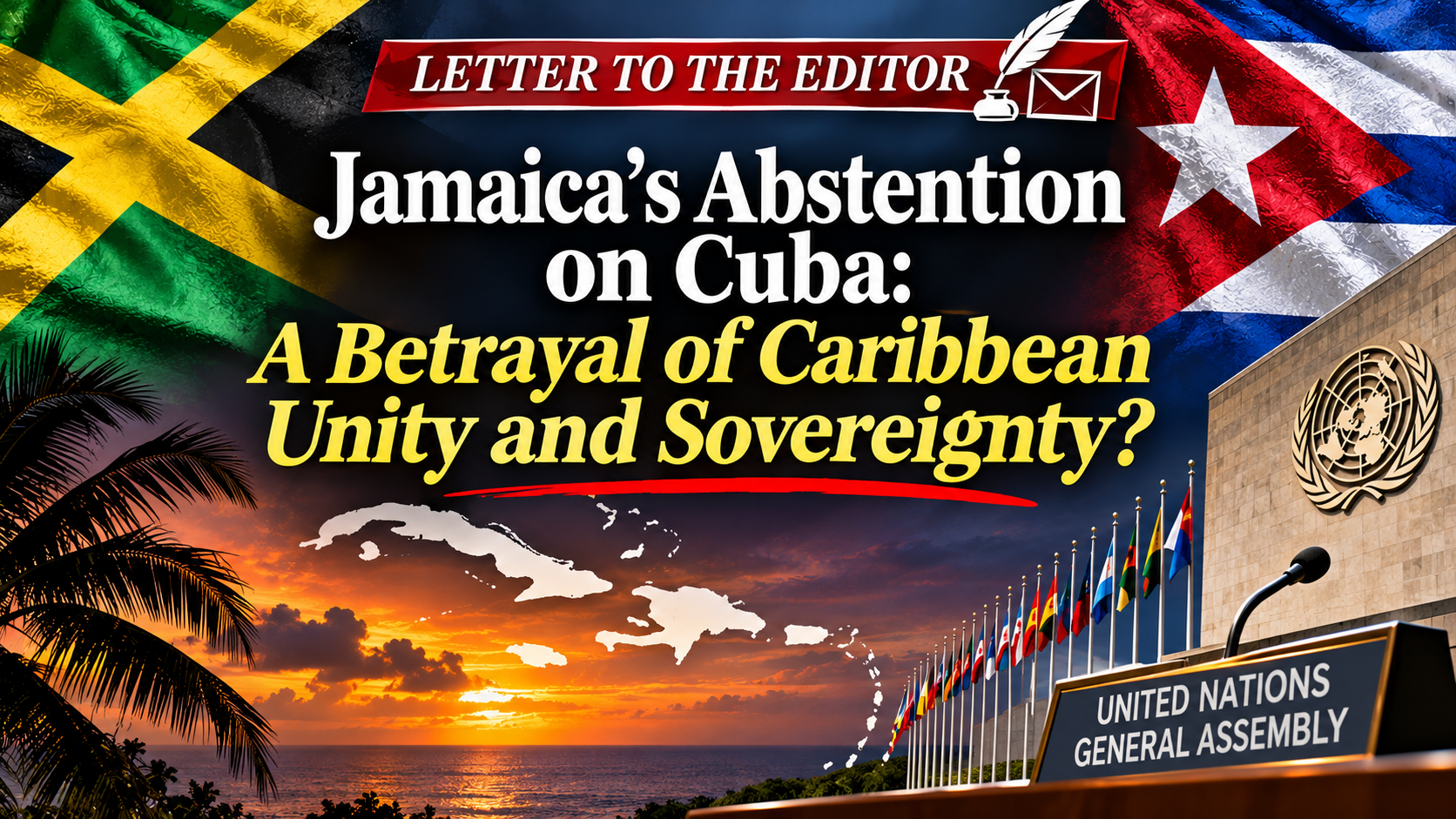
Jamaica’s historic decision on October 28, 2026, to abstain from the United Nations General Assembly resolution calling for an end to the United States’ economic embargo against Cuba raises serious questions about the government’s commitment to Caribbean unity, sovereignty, economic independence, and regional solidarity.
For decades, Cuba has endured an economic embargo imposed by the United States, restricting its economic development and international trade. Yet Cuba has remained resolute in its struggle for autonomy and sovereignty, resisting external political and economic intervention. Cuba’s struggle is inseparable from the wider Caribbean’s historical fight against colonialism, imperialism, and economic domination.
Jamaica should understand this history better than most. Its withdrawal from the West Indies Federation following the 1961 referendum contributed to the Federation’s collapse in 1962, undermining the dream of a united Caribbean nation. Now, Jamaica’s abstention on Cuba raises renewed concerns about its commitment to regional solidarity.
This decision is particularly troubling given Cuba’s longstanding cooperation with Jamaica and the wider Caribbean. Cuba has provided medical professionals, educational scholarships, healthcare assistance, and other support that has benefited our people for decades.
Historically, Jamaica maintained close relations with Cuba, particularly under Michael Manley, whose friendship with Fidel Castro reflected a commitment to Caribbean independence and Third World solidarity. Conversely, Edward Seaga’s close relationship with Ronald Reagan represented a different political and economic orientation toward Washington. This history cannot be disregarded when examining the present Jamaica Labor Party administration’s decision.
While the Jamaican government has explained that its abstention reflects concerns beyond the embargo itself, a fundamental question remains: If Jamaica opposes unilateral economic sanctions, why abstain from a resolution calling for their removal?
Jamaica’s relationship with the United States should never come at the expense of Caribbean sovereignty and regional cooperation. The United States may welcome Jamaica’s decision, but Jamaica does not need Washington’s gratitude. We need fair trade, economic opportunity, respect for sovereignty, and meaningful support for Caribbean development.
The Jamaican government owes its people and the wider Caribbean a credible explanation of how this decision advances our collective interests.
The people of Jamaica and the Caribbean must hold their governments accountable when their actions appear inconsistent with the principles of regional unity and economic independence.
Caribbean solidarity cannot be proclaimed in speeches alone; it must be demonstrated through action. The struggle for independence did not end when colonial flags were lowered. It continues wherever external economic and political pressures threaten our right to determine our own destiny.
Sincerely,
Rev. Renaldo C. McKenzie, DLS, M.Phil, M.A
Author, Neoliberalism, Globalization, Income Inequality, Poverty and Resistance
President, The Neoliberal Corporation
Host, The Neoliberal Round Podcast; Professor, Jamaica Theological Seminary
Email: [email protected]
Make a one-time donation
Make a monthly donation
Make a yearly donation
Choose an amount
Or enter a custom amount
Your contribution is appreciated.
Your contribution is appreciated.
Your contribution is appreciated.


