

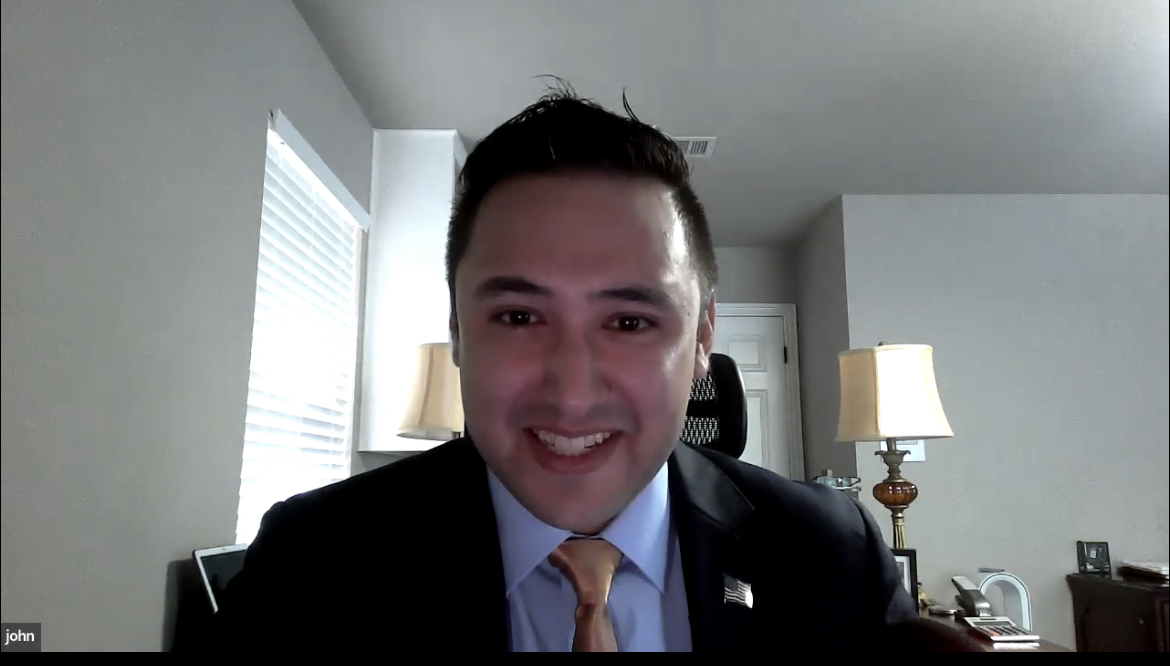
An Exclusive Interview with Renaldo C. McKenzie on The Neoliberal Round Podcast
By Renaldo C. McKenzie
The Neoliberal Post | The Neoliberal Journals
Former Republican presidential candidate John Anthony Castro remains incarcerated in federal prison as he continues challenging his conviction, questioning the conduct of federal prosecutors and the judiciary, and pursuing appeals before the United States Court of Appeals for the Fifth Circuit.
Castro, who previously challenged Donald Trump’s eligibility for the presidency under Section 3 of the Fourteenth Amendment, maintains that his criminal prosecution was politically motivated. He describes himself as a political prisoner and alleges that procedural irregularities, disputed stipulations, withheld information, and alterations to court transcripts contributed to his conviction.
These allegations remain contested and should not be mistaken for judicial findings establishing misconduct.
In an exclusive follow-up interview on The Neoliberal Round Podcast, Castro spoke with host and author Renaldo C. McKenzie about the latest developments in his legal battle, his efforts to obtain government records through the Freedom of Information Act, and his proposal for changes to federal criminal procedure.
The conversation also explored a more personal dimension of Castro’s incarceration: his family, Christian faith, prison ministry, and determination to turn his experience into an opportunity to advocate for judicial reform.
What follows is an edited dialogue from the interview.
The Fifth Circuit Appeals: Castro Alleges Procedural Fragmentation
Renaldo C. McKenzie: John, it is good to speak with you again. Since our last conversation, I have been following the developments in your case, including the articles you have published and your continued efforts to challenge your conviction.
You have been fighting several legal battles simultaneously, including appeals before the Fifth Circuit. What is the latest development in your fight for freedom?
John Anthony Castro: The latest is that the Fifth Circuit is employing a procedural tactic called “fracturing.”
Fracturing is when a case has numerous issues, any one of which could potentially overturn a conviction, but instead of considering them collectively, the court separates them into different proceedings.
That prevents the court from confronting the totality of the issues and understanding how they relate to one another.
The first decision came out, and the court said it lacked jurisdiction over the stipulations issue because, according to the court, no notice of appeal had been filed.
They said something similar regarding my allegations that the trial transcript had been altered, even though I filed a motion directly with the appeals court under Federal Rule of Appellate Procedure 10(e).
Instead of addressing the merits, they are finding procedural ways to avoid dealing with the underlying issues.
McKenzie: So your argument is that the court is examining the issues individually rather than considering whether, taken together, they raise substantial questions about the fairness of your conviction?
Castro: Exactly. They are preventing consolidation, which means the court never has to confront everything together.
And that is significant because these issues are interconnected.
The Sentencing Enhancement and the Question of Criminal Participants
McKenzie: One of the issues you raised concerns the sentencing enhancement that you say substantially increased your prison sentence. Explain what happened there.
Castro: The leadership enhancement essentially doubled my sentence.
For the enhancement they applied, at least five criminal participants are required. That means the government has to establish that I was one participant and that at least four other people were criminally responsible.
The appellate courts have consistently required that those participants be identified.
But in my case, the Fifth Circuit said it was at least plausible that four other people were involved.
They did not identify those individuals.
My conviction depended on the theory that others were involved because the employees testified that I was not personally involved in preparing the returns.
An attorney oversaw that work, and employees collected the information. They were not receiving contingency payments or bonuses that would have encouraged them to fabricate information.
The government’s theory effectively depended on a conspiracy, even though I was not charged with conspiracy.
McKenzie: So you are questioning how the government could rely on the alleged involvement of other individuals without identifying those individuals as criminal participants.
Castro: Exactly. And the standard for criminal conviction is proof beyond a reasonable doubt.
Plausibility is not the same thing.
To me, the Fifth Circuit’s reasoning exposes the weakness of the government’s case.
Editorial clarification: The legal standard for proving guilt at trial is distinct from the standards governing factual findings at sentencing. Castro disputes whether the sentencing enhancement was properly supported and applied.
Why the Government Focused on Earlier Tax Years
McKenzie: You have also argued that the government deliberately focused on certain tax years because of the way your company collected information from clients.
Castro: Correct.
They charged me with returns covering 2017, 2018, and 2019.
But from 2020 onward, through the period leading up to my indictment, we used electronic and web-based systems to collect taxpayer information, including AI Tax.
Those systems created digital records showing where the information originated.
The government focused on the earlier years when we conducted telephone interviews because those cases depended more heavily on one person’s word against another’s.
That made the evidence more vulnerable to credibility disputes.
I believe they selected those years because it would be harder to establish exactly what information was provided during those conversations.
McKenzie: And you maintain that the government relied on testimony from individuals whose credibility you believe was compromised?
Castro: Yes. I believe the government used witnesses who had vulnerabilities that could be leveraged against them.
That is part of what I have been challenging throughout this case.
Alleged Immunity Agreements and the Brady Disclosure Issue
McKenzie: Another issue concerns information about witnesses and alleged immunity agreements.
You have maintained that your defense did not receive information relevant to evaluating the credibility of government witnesses.
How does that factor into your appeal?
Castro: That is one of the central issues.
The Fifth Circuit’s opinion acknowledged that Linda Rivera had already been impeached as a witness.
The court reasoned that because her credibility had already been challenged, additional information about an immunity agreement would not have made a difference.
But that raises another question.
If the court acknowledges that a witness’s credibility had been undermined, how does it then justify relying on that testimony to support the conviction?
That is the contradiction I have been pointing out.
McKenzie: And you believe the disclosure issue should have been considered alongside the other alleged procedural irregularities?
Castro: Absolutely.
These issues should not be isolated.
They concern the integrity of the entire proceeding.
Missing Notices of Appeal and Allegations of Altered Transcripts
McKenzie: You have also raised concerns about legal mail at the federal correctional facility in Oakdale, Louisiana. You believe problems with the mail system contributed to delays in your appeals.
What happened?
Castro: I filed multiple motions explaining that the facility was losing my mail.
I tried to send documents to the court, and my electronic appeal record was also delayed for about two months.
I spent much of last summer trying to obtain it.
Eventually, the missing notice of appeal arrived at the court and was docketed.
That mattered because the court had previously relied on the missing notice of appeal when declining to address certain issues.
Now that the notice has arrived, the court must address those issues.
The government has questioned the document’s timing and suggested I may have backdated it.
But I had already been transferred to another facility. The suggestion that I somehow returned to Oakdale and planted a document in its mailroom makes no sense.
McKenzie: One of the most serious allegations you have made concerns the accuracy of the trial transcript.
You believe testimony was materially changed after it was delivered in court.
Castro: Yes, and that is the cornerstone of everything.
I have challenged the accuracy of testimony attributed to three witnesses.
In one instance, a witness clearly stated that he had supplied the information. But the transcript, as I understand it, reflected the opposite.
That is not a minor issue. That goes directly to the evidence used to convict me.
The court reporter made audio recordings, and I want those recordings examined against the written transcript.
The government has acknowledged the recordings, and the judge has addressed the issue.
The audio is critical because it could establish whether the written record accurately reflects what was said.
McKenzie: And those statements were part of the evidence considered in determining your guilt?
Castro: Yes. They were part of the evidence used to find me guilty.
McKenzie: Then the question becomes whether the appellate court will examine the original recordings and determine whether the written transcript accurately reflects the testimony.
Castro: Exactly.
This raises a much larger issue in federal courts.
We see televised proceedings in certain state courts, but federal criminal trials generally do not permit cameras in the courtroom.
The public often relies on a written transcript prepared by a court reporter.
I believe there should be greater transparency and a reliable way to verify exactly what was said during federal proceedings.
If there is nothing to hide, why not let the public examine the original record?
Will Castro’s Case Reach the Supreme Court?
McKenzie: Are you now preparing to take these matters to the United States Supreme Court, or are you still waiting for the Fifth Circuit to resolve the outstanding appeals?
Castro: We are still waiting for the Fifth Circuit.
Because the notices of appeal arrived at different times, some months apart and others even years apart, the court has been addressing the issues separately.
That creates a problem when preparing a petition for a writ of certiorari to the Supreme Court.
I do not want to submit separate petitions for every issue when they are all connected.
I have been seeking an extension so I can address these matters more coherently.
Right now, the issues I could present include the Brady violation, the leadership enhancement, and the obstruction enhancement.
McKenzie: The obstruction enhancement is another aspect of your sentence that you strongly dispute.
Castro: Yes.
They increased my sentence because they said I obstructed justice by suing an IRS agent.
But I sued the agent because I believed he violated my privacy rights under 26 U.S.C. § 6103.
The district court recognized a privacy violation in its ruling but applied a good-faith exception.
Then I was penalized for bringing the lawsuit.
The court did not find my lawsuit frivolous.
That makes absolutely no sense to me.
Freedom of Information Act Requests and the Origins of the Investigation
McKenzie: You have also been pursuing information through the Freedom of Information Act. I understand that you have filed a considerable number of requests.
What are you attempting to establish?
Castro: I have filed close to 98 FOIA requests.
One of the most significant issues concerns how the investigation against me actually began.
During my trial, IRS Special Agent Tuan Ma was asked about my public statements that the prosecution was politically motivated.
He testified that the investigation began with a computer-generated referral from the IRS Scheme Development Center.
In other words, the government presented the investigation as arising from an automated process rather than political targeting.
But we recently obtained documentation from the Treasury Inspector General for Tax Administration that raises questions about that explanation.
According to the documentation we received, a criminal inquiry began on December 16, 2017, following a human referral.
That was immediately after the Alabama special election involving Roy Moore and Doug Jones, when I became politically active in opposing the Trump administration.
McKenzie: And you believe that timing is significant?
Castro: Very significant.
Around that time, I began using resources from my business to oppose the administration’s political objectives.
Now, the documentation does not necessarily eliminate the possibility that IRS Criminal Investigation had another inquiry underway.
But it raises a question about whether the investigation truly originated from the automated referral described at trial.
The identity of the person who made the human referral and the purpose of that referral have been redacted.
We have a pending FOIA request specifically seeking the Scheme Development Center report that the agent testified initiated the investigation.
If that report exists, produce it.
That is what we are asking.
McKenzie: So the central question is whether the government can produce documentation supporting the account of how the investigation began.
Castro: Exactly.
I believe the information we are uncovering raises serious questions about how this case began.
Editorial clarification: The interview does not establish that the TIGTA inquiry and the IRS criminal investigation were the same proceeding or that the inquiry was politically directed. To reach those conclusions, the underlying documents and testimony would need to be compared.
Political Prosecution and the Department of Justice
McKenzie: You have consistently maintained that your prosecution was connected to your political opposition to Donald Trump.
You were challenging his presidential eligibility under Section 3 of the Fourteenth Amendment while also seeking the Republican presidential nomination.
How do you view your case in the broader political environment?
Castro: I believe we are seeing the weaponization of the Department of Justice against political opponents.
I have watched the way investigations and prosecutions involving political figures are discussed publicly.
The media often describes suspicious timing or unusual circumstances, but I think the questions need to be much more direct.
When government institutions are used against political opponents, everyone should care, regardless of political affiliation.
McKenzie: And your position is that the public should look beyond the fact of a conviction and examine whether the process itself was fair.
Castro: Yes.
A conviction does not mean that every decision leading up to it was correct.
That is why appeals exist, and that is why the judicial system must be open to scrutiny.
A Proposed Federal Rule to Protect Defendants from Disputed Stipulations
McKenzie: John, I want to return to something you mentioned earlier.
You recently published an article in JURIST titled “Federal Courts Should Ask Defendants Before Accepting Their Lawyer’s Concessions.”
You also submitted a proposal to the Advisory Committee on Criminal Rules concerning Federal Rule of Criminal Procedure 23.
I reviewed the September 18, 2026 memorandum from Professors Sara Sun Beale and Nancy King concerning your proposed Rule 23(d).
What exactly are you proposing?
Castro: It is a very simple reform.
Before a court accepts a stipulation that materially establishes an element of a criminal offense, the judge should personally ask the defendant whether he or she actually agreed to that stipulation.
That is all.
It would take less than a minute.
In my case, approximately 330 stipulations allegedly established almost every element of the offenses except willfulness.
The judge would have needed only to ask me directly whether I agreed to those stipulations.
I would have said no.
That one question could have prevented everything that followed.
McKenzie: So you are proposing a direct, on-the-record confirmation from the defendant whenever a stipulation substantially establishes guilt.
Castro: Exactly.
If we want a criminal justice system that minimizes doubts about the validity of convictions, why would we not adopt a safeguard like that?
It might take 30 or 45 seconds.
That is a very small price to pay to protect someone’s liberty.
McKenzie: But the committee did not proceed with the proposal?
Castro: No, it did not.
Still, the fact that the proposal reached the committee’s agenda and received serious consideration was significant.
At least the issue is now part of the public conversation.
I believe future generations will look back at some of our current criminal procedures and ask why we allowed them to continue without stronger safeguards.
Every generation thinks its justice system is functioning properly.
Then, decades later, people look back and recognize serious flaws.
I think that is what will happen with some of these practices.
Dispute Over Former Attorney’s Electronic Records
McKenzie: You also mentioned a new legal dispute involving one of your former attorneys.
Castro: Yes.
My former attorney, Nick Nicholson, had communications that I believe are relevant to the stipulations issue.
My primary attorney was Jason Freeman.
I recently filed a lawsuit in Dallas County seeking those communications.
I requested the original emails in their native electronic format so that I could examine the headers, metadata, attachments, and transmission history.
Instead, my wife received a box containing thousands of pages of printed documents, not even arranged chronologically.
That is not the same as receiving the original electronic files.
The metadata could be critical to establishing whether certain attachments were actually transmitted or received.
I also filed a complaint with the State Bar of Texas because I believe the applicable professional obligations require providing the electronic records.
McKenzie: And you believe those records could help clarify the circumstances surrounding the disputed stipulations?
Castro: Absolutely.
I want the original records so that the evidence can speak for itself.
If the records disprove my position, then let the court examine them and say so.
But withholding information only creates more questions.
The Road Ahead: Awaiting Further Decisions
McKenzie: Has the Fifth Circuit provided a timeline for deciding the remaining issues?
Castro: The court has a 30-day period to address the government’s motions for summary affirmance involving the stipulations and the motion for a new trial, as I understand the current schedule.
Those matters are directly related to the issues I have been raising.
I am continuing to fight because I believe the stipulations were central to how this conviction was obtained.
I want the court to fully examine them.
McKenzie: Your case raises questions about access to evidence, procedural fairness, defense counsel’s responsibilities, and incarcerated individuals’ ability to pursue appeals.
Whatever one’s views on your conviction, those issues deserve serious examination.
Castro: Exactly. This is about making sure the system functions as it should.
Life Behind Bars: Faith, Family, and Personal Growth
McKenzie: John, before we conclude, I want to ask about something beyond the legal proceedings.
How is your family doing?
Castro: They are doing very well, actually.
My children are still attending Christian school, and my wife is holding up well.
I thank God for continuing to provide for them and taking care of them while we go through this.
McKenzie: That is good to hear.
And how are you being treated in federal prison? How are you managing personally?
Castro: It is actually really good.
I am teaching a Christian parenting class called Malachi Dads.
Sometimes I deliver the opening sermon on Sundays.
I am also involved in a dog-training program called Canine Companions.
So I am keeping busy.
I am using this time wisely, reading, studying Scripture, and continuing to develop personally and spiritually.
McKenzie: That is encouraging, John.
Despite everything you are experiencing, you keep finding ways to serve others, deepen your faith, and stay productive.
Castro: Yes. I am trying to make the most of the situation and continue growing.
McKenzie’s Reflections: Justice, Faith, and the Fight for Freedom
McKenzie: John, I want you to know that I continue to pray for you.
I have spoken about your situation at church, and I continue to ask others to remember you in their prayers.
I believe that you will come through this experience with a powerful story to tell.
You have been fighting not only for your freedom but also for changes you believe could protect other defendants from what you have endured.
Your case should interest Americans because questions about due process and the fairness of the justice system extend beyond any one individual.
If the safeguards intended to protect one person’s rights fail, we must ask whether those same weaknesses could affect others.
I continue to believe that you deserve every opportunity to have your legal arguments fairly considered and the disputed evidence properly examined.
I also believe God is still working in your life.
Sometimes we don’t understand why certain struggles continue for so long, but I believe faith gives us the strength to persevere.
You have remained hopeful and kept fighting.
That means something.
Castro: Thank you. I appreciate that.
A Closing Prayer for John Anthony Castro
McKenzie: As we close this conversation on The Neoliberal Round Podcast, I want to offer a prayer.
Heavenly Father, we thank You for John Anthony Castro and for the strength You continue to give him.
Lord, You know his circumstances, his struggles, his family, and the battles he continues to face.
We ask that You grant him favor, wisdom, courage, and perseverance.
May truth be revealed, may justice prevail, and may fairness and integrity guide every decision about his future.
Continue to protect his wife and children. Provide for their needs and strengthen them during this period of separation.
Bless those who are working on his behalf, and inspire others to stand for justice and truth.
Lord, continue to bless this platform so we may draw attention to issues that affect others’ lives and liberties.
Your Word reminds us to always pray and not lose heart.
We thank You for what You are doing in John and through John.
In Your name we pray.
Amen.
Castro: Amen. Thank you.
A Promise to Continue the Conversation
McKenzie: John, thank you again for speaking with me.
I remain committed to following your case and reporting on developments as they emerge.
We have spoken several times, but we have yet to meet face to face. I hope we have that opportunity one day.
Castro: My wife was actually mentioning that.
McKenzie: Well, I have never been to Texas, and I must admit that I am a little nervous about going there!
Castro: We’ll see. There might be a chance coming soon.
McKenzie: I certainly hope so.
Please continue to keep me informed about new developments in your case.
And remember, you can also send articles to The Neoliberal Post and The Neoliberal Journals for publication consideration.
We will continue to provide a platform for conversations about justice, freedom, and the institutions that shape our society.
Castro: Thank you.
McKenzie: God bless you, John. Stay strong, and we’ll keep in touch.
Beyond One Conviction: The Broader Questions
John Anthony Castro’s ongoing legal battle raises questions about the relationship between criminal procedure, constitutional protections, judicial accountability, and public confidence in the justice system.
Castro alleges that disputed stipulations, incomplete disclosures, unreliable testimony, and irregularities in the appellate process influenced his conviction. He further contends that the investigation stemmed from political motives rather than the automated referral described at trial.
Those allegations require careful scrutiny against the official court record and the government’s responses. Castro’s assertions alone do not establish them, and the existence of appellate challenges does not itself show that a conviction was unlawful.
Nevertheless, the issues discussed in this interview extend beyond the circumstances of one defendant.
How should federal courts verify stipulations that effectively establish elements of a criminal offense? What safeguards should exist to ensure the accuracy of trial transcripts? How can incarcerated individuals reliably access the appellate process when their legal correspondence is delayed or lost? And what level of transparency is necessary to sustain public confidence in the administration of justice?
These questions deserve examination regardless of the defendant’s political identity or the outcome of Castro’s appeals.
For Castro, the struggle remains both legal and personal. He continues to pursue his challenges while teaching, studying, participating in prison programs, and maintaining his Christian faith.
For this publication, we remain committed to following the evidence, examining the institutions involved, and continuing the conversation about justice, accountability, and the protection of individual liberties.
The Neoliberal Round Podcast — Serving the World Today to Solve Tomorrow’s Challenges by Making Popular What Was the Monopoly.
For additional reporting, interviews, and commentary, visit The Neoliberal Post at www.theneoliberal.com and www.renaldocmckenzie.com and The Neoliberal Round Podcast https://anchor.fm/theneoliberal and YouTube Channel https://youtube.com/@renaldomckenzie
Editor’s note: This interview has been edited for clarity, readability, and organization. John Anthony Castro’s legal and factual allegations represent his account of the proceedings. Review the underlying appellate opinions, court filings, FOIA records, and responses from the individuals and agencies named before publication. Also confirm the interview date and any outstanding procedural deadlines.
Edited and published by Renaldo McKenzie, Editor-in-Chief and Publisher at The Neoliberal Corporation. Renaldo is author of The Neoliberalism Book Series: Neoliberalism, Globalization, Income Inequality, Poverty and Resistance (Book 1) is available at https://store.theneoliberal.com and online at Amazon and Barnes and Noble.
This is the edited version of an interview by Renaldo McKenzie with John A. Castro on The Neoliberal Round Podcast, available on any stream and YouTube.
Donate to us at https://donate.stripe.com/7sYcN48uybAA2OEb9V93y06
Make a one-time donation
Make a monthly donation
Make a yearly donation
Choose an amount
Or enter a custom amount
Your contribution is appreciated.
Your contribution is appreciated.
Your contribution is appreciated.