

Chester environmental justice groups take their appeal directly to Philadelphia residents. City Council prepares to consider a new Reworld contract.
By Renaldo C. McKenzie | The Neoliberal Post & The Neoliberal Journals
PHILADELPHIA, PA — August 25, 2026 — The battle over where Philadelphia sends its trash has entered a critical new phase. After years of protests, testimony, organizing, and appeals to Philadelphia officials, environmental justice advocates from Chester are taking the case. They will present it directly to the people of Philadelphia.
Their message is simple. Philadelphia cannot call itself clean and green. It sends its garbage to another predominantly Black community for burning.
Chester Residents Concerned for Quality Living (CRCQL) and allied groups urge Philadelphia residents to contact City Council. They demand two things: first, reject the new municipal waste contract with Reworld. Second, support Council member Jamie Gauthier’s Stop Trashing Our Air Act.
The campaign comes at a decisive moment. Philadelphia’s previous waste-disposal contracts expired June 30, 2026, and the Parker administration announced plans in July to award new contracts to Reworld, Waste Management and Republic Services. The proposed contracts require City Council approval. Reworld incinerates a substantial portion of Philadelphia’s municipal waste at the Delaware Valley Resource Recovery Facility in Chester.
The Philadelphia City Council will confront the issue when it returns to session in September. CRCQL says it is mobilizing volunteers in Philadelphia on August 25 and encouraging residents to telephone council members before Council resumes.
From Chester’s Streets to Philadelphia’s Doorstep
This is not the first time Chester residents have sounded the alarm.
Residents have protested outside Philadelphia City Hall, testified before City Council, organized what activists call “toxic tours,” and demonstrated outside Mayor Cherelle Parker’s public events. In April, CRCQL members staged a symbolic “die-in” outside City Hall while Philadelphia officials discussed upcoming waste contracts. In May, activists protested outside Mayor Parker’s town hall in Kingsessing.
The Neoliberal Post has also followed the struggle. In June, we reported on Chester residents bringing their protest into West Philadelphia and examined the contradiction at the heart of Philadelphia’s environmental ambitions: Can Philadelphia become “cleaner and greener” by exporting part of its waste’s environmental burden to Chester?
Now the movement is turning toward Philadelphia residents themselves.
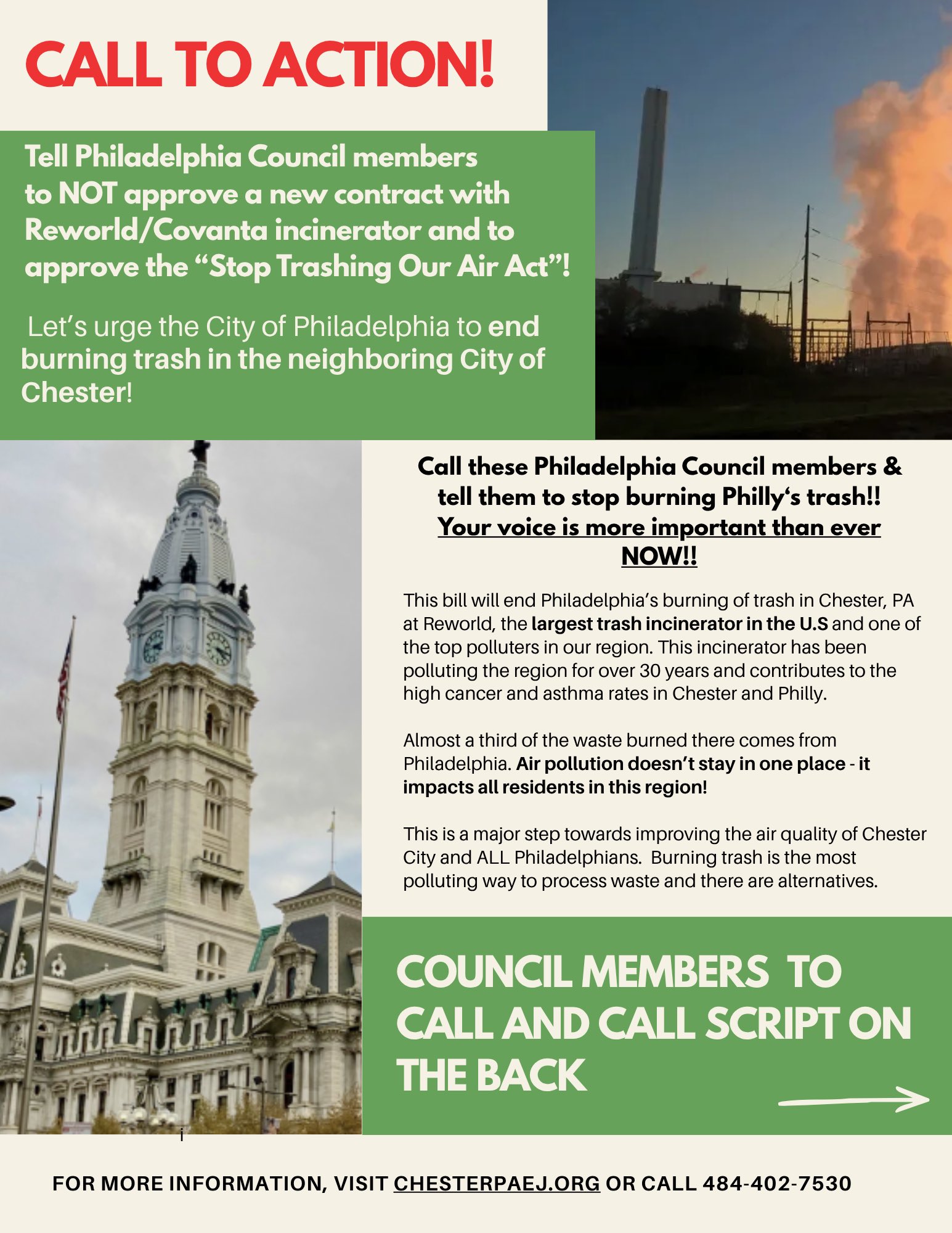
The flyer being circulated by organizers declares:
“Your voice is more important than ever NOW!!”
Residents are being urged to tell Council not to approve a new Reworld contract and instead pass legislation designed to end Philadelphia’s contracting with companies that incinerate municipal solid waste or recyclables.
What Is the Stop Trashing Our Air Act?
Council member Jamie Gauthier introduced the Stop Trashing Our Air legislation in September 2025. The proposal would prohibit Philadelphia from entering new waste-disposal contracts with companies that burn the city’s solid waste or recyclables.
The measure was scheduled for consideration earlier this year but was held in January after it became apparent that it did not have enough support to pass. Gauthier said at the time that colleagues wanted additional time to consider the legislation.
Meanwhile, the stakes have grown considerably.
Philadelphia officials announced in July that they intended to move forward with Reworld as one of three companies selected to process and dispose of municipal waste. The proposed arrangement would be a four-year contract with options that could extend it by another three years.
That means decisions made now could shape where Philadelphia’s trash goes for years.
Why Chester?
The Reworld facility sits along the Delaware River in Chester, Delaware County — not Chester County, as the names are sometimes confused. Chester is a majority-Black city roughly 15 miles southwest of Philadelphia.
The facility is widely reported as the largest municipal waste incinerator in the United States. Philadelphia currently sends about 40 percent of its trash to the site, accounting for roughly one-third of the waste processed there.
For Chester residents, however, this is about far more than percentages.
It is about who gets to breathe clean air and who carries the environmental costs of metropolitan life.
CRCQL has been organizing around environmental justice in Chester since 1992. Residents and activists have long argued that concentrating waste infrastructure and pollution in a predominantly Black, economically disadvantaged community represents a textbook environmental justice problem.
Waste incineration releases pollutants including nitrogen oxides, sulfur dioxide, particulate matter and metals. Advocates argue that adding emissions from waste generated outside Chester compounds an already heavy environmental burden.
Residents have also described generations of asthma, respiratory problems and cancer in their families and neighborhoods. Those experiences have become central to the movement’s argument that what happens to Philadelphia’s trash after the sanitation truck leaves the block cannot simply be treated as someone else’s problem.
Reworld Disputes the Characterization
There is another side to the dispute.
Reworld maintains that its Chester facility operates safely and in compliance with state and federal environmental regulations. A company spokesperson told The Philadelphia Tribune that the facility operates significantly below federal emissions limits and cited a third-party human-health risk assessment that, according to the company, found potential risks below EPA thresholds.
Philadelphia officials have also argued that simply replacing incineration with landfill does not eliminate the environmental consequences of waste disposal.
Carlton Williams, director of Philadelphia’s Office of Clean and Green Initiatives, has said both approaches carry environmental costs and that the city needs to move beyond the choice between incinerators and landfills. Officials have pointed to alternatives such as anaerobic digestion as part of a longer-term waste strategy.
That is an important point.
But it does not resolve the ethical question Chester residents are placing before Philadelphia.
Who should bear the cost of Philadelphia’s consumption?
The Politics Behind the Trash
The controversy has also raised questions about political influence.
Public records reviewed by WHYY showed that Reworld spent $45,000 lobbying Philadelphia City Council members and the Parker administration during the final quarter of 2025, as officials were considering legislation that could affect the company’s ability to obtain future city contracts. Reworld’s political action committee also contributed $3,700 to Parker’s campaign in December 2025.
Those expenditures are legal political activities, but their timing has fueled criticism from activists who argue that ordinary Chester residents are being forced to compete for political influence against a corporation with substantially greater resources.
That tension goes to the center of the environmental justice debate: Who has access to power, and whose suffering becomes politically negotiable?
A Regional Problem, Not Merely a Chester Problem
The campaign’s appeal to Philadelphia residents also carries an important reminder: air does not recognize municipal boundaries.
The smoke does not stop at Chester’s city line.
Pollution released into the regional air shed can affect communities beyond the immediate neighborhood surrounding an industrial facility. Organizers therefore argue that ending Philadelphia’s dependence on incineration is not simply an act of solidarity with Chester; it is part of a broader conversation about public health and environmental policy throughout southeastern Pennsylvania.
The question is not whether Philadelphia must dispose of its waste. Of course it must.
The deeper question is whether one city can build its environmental progress upon another city’s environmental burden.
There is something profoundly contradictory about sweeping one’s own doorstep while throwing the dirt onto a neighbor’s porch.
Philadelphia Residents Are Now Being Asked to Act
CRCQL’s current campaign asks Philadelphia residents to contact City Council before lawmakers consider the new waste contracts.
The group’s flyer specifically identifies District 1 council member Mark Squilla, listing his office numbers as 215-686-3458 and 215-686-3459 and his email as [email protected].
The suggested message asks residents to urge Council to support the Stop Trashing Our Air Act, oppose a new Reworld contract, and end the practice of sending Philadelphia municipal waste to Chester for incineration.
The organizers’ central declaration deserves to be heard beyond Chester:
“You cannot have a Clean & Green Philadelphia while trashing another community.”
Whether one agrees with every argument made by the activists or with every proposed policy solution, that statement raises a question Philadelphia cannot escape.
A sustainable city cannot merely make pollution disappear from sight.
It must ask where the pollution goes.
It must ask who lives there.
And it must ask who pays the price.
The September Decision
City Council’s return in September makes the coming weeks critical.
Philadelphia collects more than 600,000 tons of municipal trash annually, making the decision about where that waste goes a major environmental and public-policy question for the region.
For Chester residents who have spent decades fighting what they describe as environmental injustice, however, September represents something more intimate.
It represents another chance to be heard.
Another chance for Philadelphia officials to decide whether the city’s pursuit of a cleaner future includes the communities beyond its borders.
And another chance for ordinary Philadelphia residents to decide whether Chester’s air is their concern too.
The people of Chester are now asking Philadelphia for help.
The question is whether Philadelphia will answer.
Call to Action
Philadelphia residents can contact their City Council representatives and urge them to oppose a new Reworld waste-disposal contract and support the Stop Trashing Our Air Act.
For information about Chester Residents Concerned for Quality Living and the campaign, visit Chester Environmental Justice / CRCQL.


The Neoliberal Post and The Neoliberal Journals will continue to follow the Philadelphia-Reworld contract, the Stop Trashing Our Air Act, and Chester’s ongoing struggle for environmental justice.
Email The Neoliberal at [email protected]
Subscribe to our Podcast on any stream. Find your stream at https://anchor.fm/theneoliberal or via our YouTube Channel at https://youtube.com/@renaldomckenzie
Written and Edited by Renaldo McKenzie

Get a copy of our book by Renaldo McKenzie: Neoliberalism. Visit https://store.theneoliberal.com
Make a one-time donation
Make a monthly donation
Make a yearly donation
Choose an amount
Or enter a custom amount
Your contribution is appreciated.
Your contribution is appreciated.
Your contribution is appreciated.