

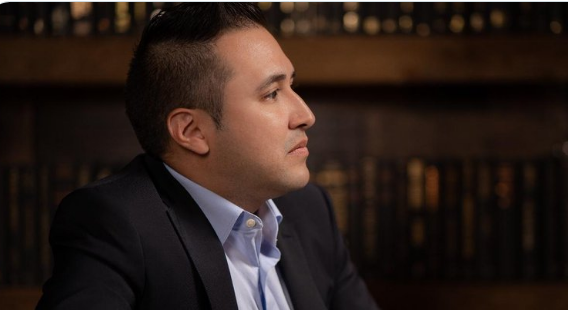
There is a man sitting in a federal prison camp in Louisiana who insists that his case is not over—no matter how many voices online declare it buried.
John Anthony Castro, former presidential candidate and one-time legal challenger to Donald Trump under Section 3 of the 14th Amendment, spoke from confinement this week with a clarity that cuts through the noise: his appeal is still active. Not rumored, not speculative—active. Pending before a three-judge panel of the U.S. Court of Appeals for the Fifth Circuit.
And yet, somewhere in the public square, a different story is being told.
That dissonance—between the official docket and the digital whisper—is where this story truly lives.
Castro says the briefs are in. The arguments are made. The machinery of appellate review has already begun its quiet rotation. Sixty to ninety days, he says. By summer’s end—before July 1—there should be an answer.
But what kind of answer will it be? And perhaps more importantly: what kind of system delivers it?
The Silence of the Courts
At the heart of Castro’s argument is something deceptively simple—a silence where there should be speech.
He claims that both the district court and the Fifth Circuit denied his motion for release pending appeal without issuing a statement of reasons, a requirement under Federal Rule of Appellate Procedure 9(a). In law, silence is rarely neutral. It is either restraint—or avoidance.
If true, the implication is unsettling: a judiciary that declines to explain itself while exercising its most consequential power—denial of liberty.
The law demands reasons. Not gestures. Not conclusions. Reasons.
And yet, according to Castro, none were given.
So he waits—not just for judgment, but for explanation.
A Trial Under Question
Castro does not speak in half-measures. He alleges that his trial was compromised at every stage—before, during, and after.
He claims forged stipulations were entered into the record. He claims a witness was pressured into false testimony. He claims the court transcript itself was altered through improper communication between prosecutor and court reporter.
These are not minor complaints. They are not procedural quibbles. They are, if true, indictments of the process itself.
But here is where the story tightens its grip: these claims are not yet adjudicated truths. They are allegations—serious ones—awaiting the scrutiny of the appellate court.
Still, their presence raises a deeper question: what happens when the legitimacy of the process becomes the issue on appeal?
Punishment, Power, and Timing
Castro was sentenced to 188 months—over 15 years—what he describes as the harshest tax-related sentence in decades. He believes the severity was not incidental but intentional—a warning, he says, to those who challenge power at its highest level.
That claim, like others, remains unproven in a court of law.
But the timing cannot be ignored.
A presidential campaign. A lawsuit against a former president. Then an indictment. Then imprisonment. Then the collapse of his company, AI Tax. Then silence—legal, institutional, systemic.
Even coincidence, when it gathers in clusters, begins to look like design.
The Human Cost
Behind the legal filings and constitutional arguments is something quieter—a life interrupted.
Castro says his company is gone. Burned down to the ground. But his family remains intact—his wife and children adapting, surviving, enduring.
And in that space—between loss and survival—something else has emerged.
Faith.
He speaks not as a politician now, nor strictly as a litigant, but as a man reshaped by confinement. He talks of ministry. Of service. Of pro bono work. Of walking alongside others who have suffered injustice.
It is an unexpected turn, but perhaps not an uncommon one. History is crowded with men who entered prison as one thing and left as another.
The fire, he suggests, did not just destroy—it revealed.
A System on Trial
Castro’s case is, on paper, about tax fraud, appellate procedure, and constitutional claims. But in spirit, it has become something else: a test of whether the system can explain itself when pressed.
Because here is the quiet danger—not that a man claims injustice, but that the system responds without explanation.
When courts do not speak, others will. And not always truthfully.
Misinformation thrives in the vacuum of official silence. Castro says people are already declaring his appeal dead when it is very much alive. That gap—between fact and narrative—is where public trust erodes.
Waiting for Summer
And so, we wait.
Somewhere between April and June, three judges will decide whether Castro’s claims hold weight or collapse under scrutiny. Whether the process was sound or flawed. Whether silence was justified—or unlawful.
Until then, the case remains what Castro insists it is: unresolved.
Not finished. Not buried. Not forgotten.
Just waiting.
And in that waiting—like a held breath—the question lingers:
Is this merely the appeal of one man… or a mirror held up to the system itself?
By Renaldo McKenzie
The Neoliberal Post
Renaldo is author of Neoliberalism, Globalization, Income Inequality, Poverty and Resistance available at https://store.theneoliberal.com
Email us at [email protected]
Call us at 445-260-9198
Donate to us
Make a one-time donation
Make a monthly donation
Make a yearly donation
Choose an amount
Or enter a custom amount
Your contribution is appreciated.
Your contribution is appreciated.
Your contribution is appreciated.